* This week the KSO will once again be participating in Orchestras Feeding America. We will be collecting canned goods at our concerts on Thursday and Friday. There are children and seniors right here in our community who go to bed hungry because they do not have enough to eat. We can make a direct difference.
* Continuing in the spirit of giving to the community, Lucas will be participating in Knoxville's very own Dancing with the Stars on Thursday, April 1st. Although the event takes place on April Fools Day, it is no joke. This is a fundraiser for East Tennessee Children's Hospital. You can vote with your wallet; every vote costs $1 and all proceeds benefit the hospital. I've never seen Lucas dance, but my guess is he's quite dapper. Vote early and vote often!
* Have you seen these PSA's for the Arts? They seem to have been out for awhile but I've never seen them on television. Knox county is getting ready to ax some more arts programs in the schools. Perhaps they need a good dose of Raisin Brahms or Van Goghgurt.

Showing posts with label Masterworks. Show all posts
Showing posts with label Masterworks. Show all posts
Monday, March 22, 2010


Thursday, February 25, 2010
Different Perspective
Athleticism has never been my prowess. When I perform as a soloist or as part of a quartet the thing that keeps me up at night is not the actual playing, it is the mere act of walking out on stage. I am a step aerobics teacher's nightmare because, for as much as I can control my fine motor skills, I am a gross motor dunce. So, I shouldn't have been shocked when, on Monday, I did my best impression of an Olympic ski crash. Only I was just walking. And there wasn't any snow. (Yes, I know that in there, somewhere, there is a viola joke just begging to be had.)
I'm fine. I'm not sure which is more badly bruised, my arm or my ego. I am, however, out for the week. This afforded me a rare chance to check out the symphony from the audience. Last night I attended the dress rehearsal for tonight and tomorrow night's Masterworks performances. It was fun, I really enjoyed listening. Things sound very different in the hall then they do from the first desk of the viola section. Last night the orchestra sounded particularly great in Tchaikovsky's Romeo and Juliet.
Mendelssohn's Incidental Music to A Midsummer Night's Dream features actors from the Clarence Brown Theatre. It was quite entertaining. I got the giggles hearing the character of Thisbe performed in Shakespearean English with a Southern accent. If you are attending the concert and aren't familiar with the play, I would advise reading a synopsis. The actors from Clarence Brown are playing more than one role apiece, differentiated with different hats, and, of course, are not performing the entire play. It was interesting to see how Lucas and the actors from Clarence Brown put this together. There is a good balance of the actors and orchestra taking turns being the main focus. I was also pleasantly surprised at how much the orchestral passages enhanced the mood of the play. If you are able to brave this horrible winter weather we are having, I highly recommend attending tonight or tomorrow.
I'm fine. I'm not sure which is more badly bruised, my arm or my ego. I am, however, out for the week. This afforded me a rare chance to check out the symphony from the audience. Last night I attended the dress rehearsal for tonight and tomorrow night's Masterworks performances. It was fun, I really enjoyed listening. Things sound very different in the hall then they do from the first desk of the viola section. Last night the orchestra sounded particularly great in Tchaikovsky's Romeo and Juliet.
Mendelssohn's Incidental Music to A Midsummer Night's Dream features actors from the Clarence Brown Theatre. It was quite entertaining. I got the giggles hearing the character of Thisbe performed in Shakespearean English with a Southern accent. If you are attending the concert and aren't familiar with the play, I would advise reading a synopsis. The actors from Clarence Brown are playing more than one role apiece, differentiated with different hats, and, of course, are not performing the entire play. It was interesting to see how Lucas and the actors from Clarence Brown put this together. There is a good balance of the actors and orchestra taking turns being the main focus. I was also pleasantly surprised at how much the orchestral passages enhanced the mood of the play. If you are able to brave this horrible winter weather we are having, I highly recommend attending tonight or tomorrow.
Thursday, January 21, 2010
To Clap or Not to Clap
Our Masterworks concert last Friday caused quite a stir amongst us musicians. The audience applauded between each and every movement during the concert. They even made the review in the News Sentinel. This sparked a somewhat heated backstage debate on audience etiquette. Musician's opinions on the subject fell on a wide spectrum from some really enjoying applause between movements to others who couldn't stand it and felt the symphony should post signs instructing audiences to wait. Who knew applause could be so controversial?!
The practice of holding applause until the end of a multi-movement work is relatively young. In fact, up until the late 1800's, it was common practice not only to applaud between movements but also to clap DURING the movement. Composers rejoiced with audience applause and were upset when it was withheld. The seeds of silence seem to have been planted in the late 1800's with the premier of Wagner's Parsifal when the singers agreed not to take a curtain call to avoid disrupting the flow of the opera. Mahler also played a role by policing claques, which essentially were people paid to enthusiastically applaud often to the point of disrupting the performance. (At that time, people were also paid to laugh, cry and boo. Guest artists were often exhorted to pay a fee to the concert house to avoid having the booing audience present at their performance.)
But perhaps the biggest champion of squelching audience applause between movements was Leopold Stokowski in the 1930's. Actually, Stokowski was opposed to applause at any time during the concert. He felt it was as absurd to applaud at a concert as it would be to stand in front of a great work of visual art and applaud. It was such a hot topic that eventually the Philadelphia audience was put to a vote. Applause overwhelmingly won out.
The practice of not applauding between movements was slow to spread and didn't really take hold until the 1950's. I haven't been able to find out why that happened at that time. Perhaps people were becoming accustomed to silence between movements through the recordings they were playing at home. I think another real possibility is that it was a way that classical music could distinguish itself as being more civilized than the emerging popular music of the day.
Personally, applause between movements doesn't really bother me. To me, "inapproprate" applause means that we have new audience members (yay!) who will hopefully come back. Besides, I don't really understand how you can be upset with someone who is paying you a compliment. Audiences applaud out of appreciation. I can't imagine anything much worse than getting to the end of a performance and standing up to stony silence. Likewise, if I were an audience member who was glared at for applauding I would not be likely to return for another performance.
In my view, rules such as this are a major contributor to the decline of classical music. Going to a concert shouldn't be a difficult experience fraught with random unspoken rules. The thing I hear most from people who have never attended a symphony concert is that they are intimidated. Symphonies around the country have tried to combat this by offering blue jeans concerts, rush hour concerts, concerts of lite classics, etc, etc, etc. This is a good start, but I don't think there will be a true mass cross-over of audience until the unspoken rules of concert-going are either clearly defined or abolished.
What do you think about applause between movements? Is it a random rule or does it serve a purpose?
The practice of holding applause until the end of a multi-movement work is relatively young. In fact, up until the late 1800's, it was common practice not only to applaud between movements but also to clap DURING the movement. Composers rejoiced with audience applause and were upset when it was withheld. The seeds of silence seem to have been planted in the late 1800's with the premier of Wagner's Parsifal when the singers agreed not to take a curtain call to avoid disrupting the flow of the opera. Mahler also played a role by policing claques, which essentially were people paid to enthusiastically applaud often to the point of disrupting the performance. (At that time, people were also paid to laugh, cry and boo. Guest artists were often exhorted to pay a fee to the concert house to avoid having the booing audience present at their performance.)
But perhaps the biggest champion of squelching audience applause between movements was Leopold Stokowski in the 1930's. Actually, Stokowski was opposed to applause at any time during the concert. He felt it was as absurd to applaud at a concert as it would be to stand in front of a great work of visual art and applaud. It was such a hot topic that eventually the Philadelphia audience was put to a vote. Applause overwhelmingly won out.
The practice of not applauding between movements was slow to spread and didn't really take hold until the 1950's. I haven't been able to find out why that happened at that time. Perhaps people were becoming accustomed to silence between movements through the recordings they were playing at home. I think another real possibility is that it was a way that classical music could distinguish itself as being more civilized than the emerging popular music of the day.
Personally, applause between movements doesn't really bother me. To me, "inapproprate" applause means that we have new audience members (yay!) who will hopefully come back. Besides, I don't really understand how you can be upset with someone who is paying you a compliment. Audiences applaud out of appreciation. I can't imagine anything much worse than getting to the end of a performance and standing up to stony silence. Likewise, if I were an audience member who was glared at for applauding I would not be likely to return for another performance.
In my view, rules such as this are a major contributor to the decline of classical music. Going to a concert shouldn't be a difficult experience fraught with random unspoken rules. The thing I hear most from people who have never attended a symphony concert is that they are intimidated. Symphonies around the country have tried to combat this by offering blue jeans concerts, rush hour concerts, concerts of lite classics, etc, etc, etc. This is a good start, but I don't think there will be a true mass cross-over of audience until the unspoken rules of concert-going are either clearly defined or abolished.
What do you think about applause between movements? Is it a random rule or does it serve a purpose?
Thursday, January 14, 2010
Good Beginning, Good Ending
One of the best things about being a musician is the endless variety in the work. In about a 10 day time span, the KSO has performed or will perform a pops concert, a children's concert, a pair of Masterworks concerts, and a concert honoring Martin Luther King Jr. Not to mention the string quartets that have been out and about in the community. Today I started my day with our Family concert performance for a hall full of school children and I will end it with (hopefully!) a hall full of people for our January Masterworks concert. Good beginning, good ending.
Monday, January 4, 2010
Hi Ho, Hi Ho....
This week the KSO is back to work after a two-week vacation. I admit I put the viola down for a few days over the break. Today, eyeing the stack of music waiting on my stand, I see that we've got a lot coming up in the next 10 days or so.
This weekend we're playing our first Pops concert of the season. The Piano Man features music from the 1970's, specifically, the music of Elton John and Billy Joel. Now, I don't remember the 1970's. (Actually, I wasn't around for most of the decade.) I do know many of the tunes we'll be playing, though. Elton John and Billy Joel have so many hits it's impossible not to know their music. Both have penned songs that have stood the test of time and remained popular across generations. I love Pops concerts where I've heard all the charts. This is a good one to come see, even if you aren't particularly versed in pop music. If I know the songs, you will too. Trust me. I am the dunce of pop music.
My position on the stage is a prime spot for people watching. (If you've ever wondered if the orchestra watches the audience, there's your answer.) Pops concerts, in particular, are great for audience-watching. The atmosphere at a pops concert is much different than at a masterworks or chamber concert. Pops concerts encourage more audience participation than traditional concerts. Dancing in the aisles is not uncommon, and the audience is often invited to sing along. That just doesn't happen in the middle of a performance of a Beethoven symphony. Maybe it should....
This weeks pops concert will take place on Sat, Jan 9 at 8:00. It will be nice and warm inside the Civic, I promise.
This weekend we're playing our first Pops concert of the season. The Piano Man features music from the 1970's, specifically, the music of Elton John and Billy Joel. Now, I don't remember the 1970's. (Actually, I wasn't around for most of the decade.) I do know many of the tunes we'll be playing, though. Elton John and Billy Joel have so many hits it's impossible not to know their music. Both have penned songs that have stood the test of time and remained popular across generations. I love Pops concerts where I've heard all the charts. This is a good one to come see, even if you aren't particularly versed in pop music. If I know the songs, you will too. Trust me. I am the dunce of pop music.
My position on the stage is a prime spot for people watching. (If you've ever wondered if the orchestra watches the audience, there's your answer.) Pops concerts, in particular, are great for audience-watching. The atmosphere at a pops concert is much different than at a masterworks or chamber concert. Pops concerts encourage more audience participation than traditional concerts. Dancing in the aisles is not uncommon, and the audience is often invited to sing along. That just doesn't happen in the middle of a performance of a Beethoven symphony. Maybe it should....
This weeks pops concert will take place on Sat, Jan 9 at 8:00. It will be nice and warm inside the Civic, I promise.
Thursday, December 31, 2009
Five Things I'm Looking Forward to in 2010
* Playing with Rachel Barton Pine this January. I'm an Illinois girl, I grew up about an hour from Chicago. When I was young the Chicago Symphony had a youth concerto competition and broadcast the finals on television. The first year I watched, Rachel Barton Pine was a finalist, playing Sarasate's Carmen Fantasy. At the time I had been studying the violin for two years through school and had not yet started taking private lessons. Her performance was so exciting I could hardly sit still to watch. It was pivotal in my decision to become serious about music. I can't wait to hear her play Brahms.
* Collaborating with Clarence Brown Theatre on the February Masterworks concert. I really like Mendelssohn's incidental music to A Midsummer Night's Dream anyway. I'm anticipating that the actors will make it even better. This is a collaboration that a lot of the orchestra is buzzing about. Before my time here there was a collaboration on another Shakespeare play (Hamlet? Macbeth?) that people are still talking about.
* Mozart Requiem in April. I LOVE this piece. I say that about most things we play, but I really, truly, adore the Mozart Requiem. For me it's up there with Beethoven's 9th Symphony (which is my absolute favorite piece of music).
* Speaking of Beethoven's 9th, I'm going to go out on a limb and guess that we might be performing this next season. I don't know this for sure, but we *have* been performing a Beethoven symphony every year and next year *is* the orchestra's 75th anniversary... This is a prediction only, and like many predictions about the new year, it may not actually happen. After all, the earth hasn't imploded and we are not ruled by a population of giant ant-people. A girl can wish, though. (For Beethoven's 9th, not the giant ant-people.)
* Which leads me to the final thing I'm looking forward to about 2010: the announcement of the KSO's 2010 - 2011 75th anniversary season! I'm sure it will be a great season and will give us all wonderful things to look forward to in the second half of 2010.
* Collaborating with Clarence Brown Theatre on the February Masterworks concert. I really like Mendelssohn's incidental music to A Midsummer Night's Dream anyway. I'm anticipating that the actors will make it even better. This is a collaboration that a lot of the orchestra is buzzing about. Before my time here there was a collaboration on another Shakespeare play (Hamlet? Macbeth?) that people are still talking about.
* Mozart Requiem in April. I LOVE this piece. I say that about most things we play, but I really, truly, adore the Mozart Requiem. For me it's up there with Beethoven's 9th Symphony (which is my absolute favorite piece of music).
* Speaking of Beethoven's 9th, I'm going to go out on a limb and guess that we might be performing this next season. I don't know this for sure, but we *have* been performing a Beethoven symphony every year and next year *is* the orchestra's 75th anniversary... This is a prediction only, and like many predictions about the new year, it may not actually happen. After all, the earth hasn't imploded and we are not ruled by a population of giant ant-people. A girl can wish, though. (For Beethoven's 9th, not the giant ant-people.)
* Which leads me to the final thing I'm looking forward to about 2010: the announcement of the KSO's 2010 - 2011 75th anniversary season! I'm sure it will be a great season and will give us all wonderful things to look forward to in the second half of 2010.
Monday, November 2, 2009
November in a Nutshell
There is a lot going on with the KSO in November!
Last week the KSO performed educational concerts for thousands of area school children. Beginning this week and continuing through the month, small ensembles of musicians will be touring the Knox County Public Library branches for special musical story time presentations. These are always very entertaining. I have participated in story time concerts both as a musician and as an audience member with my daughter. It's hard to say which was more fun. There are many opportunities for the children to participate, from singing along with familiar tunes to playing small percussion instruments. It is a great (and free!) way to introduce young children to live classical music. The full story time schedule can be found here.
This week is also the KSO's debut Chamber Classics Series performance of the season. Sunday afternoon's concert is a concert of string serenades by Tchaikovsky, Elgar, and Suk. Don't let the parking situation around the Bijou deter you from attending this concert. Once again the KSO will be providing a shuttle service from the State Street Garage (behind the Tennessee Theater) to the Bijou.
On the 16th the Knoxville Symphony Youth Orchestras will give their first performance of the season. These kids work incredibly hard and their concerts are not to be missed.
Later in the month is the November Masterwork's Concert featuring pianist Benjamin Hochman playing Mendelssohn. We'll also be playing Der Rosenkavalier Suite by Strauss, the gorgeous Prelude and Liebestod from Wagner's Tristan und Isolde and Haydn's 16th Symphony.
Also mid-month is our first Family Concert of the season. Picardy Penguin will be back in a program entitled, "Shall we Dance?" Our family concerts are more like events than concerts. There are plenty of activities for children and their families to participate in before the actual concert. It's a nice way to spend a cold afternoon.
Finally, the end of the month brings two free community performances. On November 27th (aka, "Black Friday") at 6:00 the KSO Brass Quintet will be performing in Krutch Park near Market Square for the City of Knoxville Celebration of Lights. The next day a string quartet will be at West Town Mall playing holiday music.
Last week the KSO performed educational concerts for thousands of area school children. Beginning this week and continuing through the month, small ensembles of musicians will be touring the Knox County Public Library branches for special musical story time presentations. These are always very entertaining. I have participated in story time concerts both as a musician and as an audience member with my daughter. It's hard to say which was more fun. There are many opportunities for the children to participate, from singing along with familiar tunes to playing small percussion instruments. It is a great (and free!) way to introduce young children to live classical music. The full story time schedule can be found here.
This week is also the KSO's debut Chamber Classics Series performance of the season. Sunday afternoon's concert is a concert of string serenades by Tchaikovsky, Elgar, and Suk. Don't let the parking situation around the Bijou deter you from attending this concert. Once again the KSO will be providing a shuttle service from the State Street Garage (behind the Tennessee Theater) to the Bijou.
On the 16th the Knoxville Symphony Youth Orchestras will give their first performance of the season. These kids work incredibly hard and their concerts are not to be missed.
Later in the month is the November Masterwork's Concert featuring pianist Benjamin Hochman playing Mendelssohn. We'll also be playing Der Rosenkavalier Suite by Strauss, the gorgeous Prelude and Liebestod from Wagner's Tristan und Isolde and Haydn's 16th Symphony.
Also mid-month is our first Family Concert of the season. Picardy Penguin will be back in a program entitled, "Shall we Dance?" Our family concerts are more like events than concerts. There are plenty of activities for children and their families to participate in before the actual concert. It's a nice way to spend a cold afternoon.
Finally, the end of the month brings two free community performances. On November 27th (aka, "Black Friday") at 6:00 the KSO Brass Quintet will be performing in Krutch Park near Market Square for the City of Knoxville Celebration of Lights. The next day a string quartet will be at West Town Mall playing holiday music.
Thursday, October 22, 2009
October Masterworks
Tonight and tomorrow night are the KSO's October Masterworks Concerts. I wish I could let you in on the backstage scoop for this concert, but really, I don't know what's been happening. I've been out sick all week with a little virus that is sweeping the country. I can tell you that this concert series is a tour de force for the orchestra. There is no soloist, but like our opening concert in September, these pieces feature a lot of different players and sections in the orchestra. Petrushka in particular is a showcase for KSO pianist Carol Zinavage. From the chatter I've seen on Facebook, everyone is excited about the concert and has been working extra-hard. (Surely there must be a law against practicing the piccolo before 9am?) Good luck to all, I'm sure it will be a wonderful concert!
Monday, October 19, 2009
Unfamiliar Works
This weeks Masterworks concert features three pieces that may be unfamiliar to listeners. Actually, the works are unfamiliar to many of the musicians as well. When I'm faced with an unfamiliar piece, I like to learn about it and listen to it. With the internet this is a lot easier to do now than it was 10 years ago!
Each of the pieces tells a story, and the program notes just happen to be on the KSO website.
The notes on Richman's An Overture to Blanche can be found here, the notes on Dvorak's The Golden Spinning Wheel are here, and the program notes on Stravinsky's Petrushka are here.
Also, you can listen to the podcast, which is located right under our sponsor for this concert, The Trust Company.
As I've mentioned before, the Knox County Public Library is a great source of classical music recordings. YouTube also has recordings of The Golden Spinning Wheel (here is part two and part three) and Petrushka (here are parts two, three, and four.)
Each of the pieces tells a story, and the program notes just happen to be on the KSO website.
The notes on Richman's An Overture to Blanche can be found here, the notes on Dvorak's The Golden Spinning Wheel are here, and the program notes on Stravinsky's Petrushka are here.
Also, you can listen to the podcast, which is located right under our sponsor for this concert, The Trust Company.
As I've mentioned before, the Knox County Public Library is a great source of classical music recordings. YouTube also has recordings of The Golden Spinning Wheel (here is part two and part three) and Petrushka (here are parts two, three, and four.)
Monday, October 12, 2009
Petrushka
In one week we will begin rehearsals for our next Masterworks concert. I'm geeky in that I truly love 99% of all the music we play. Even pieces that I'm not enamored with on first reading usually grow on me throughout the rehearsal process. This concert, though, I have been anticipating since the '09-'10 season was announced last year. I love Petrushka. It's in my top 20 of favorite orchestral works and it's certainly my favorite piece by Stravinsky to play. I like Petrushka so much that I'm even looking forward to practicing it, and, as you know, practicing is not my favorite activity.
So why is Petrushka so great? Well, the music was actually written for the ballet, so it's programmatic. You can visualize the story when you hear the music. Petrushka is the story of three puppets who have been brought to life by magic. There is a love triangle, fighting, a death, and, ultimately Petrushka himself becomes an angry ghost. How can you NOT like a story like that?! The music itself brings the story to life. We can hear Petrushka, the bustling market square, the beautiful ballerina, and the slow but powerful Moore.
I will say that the first time I played Petrushka it was not one of my favorites. I liked it but I didn't think it was that special. It was one of those pieces that grew on me after getting to know it better. Now, obviously, I love it. This is a piece that becomes more enjoyable the more times you listen to it. Actually, I think this is true of all classical music. Listening to music is not like going to a movie. Knowing the ending already won't diminish your enjoyment of subsequent listenings. In fact, the opposite is true. Take holiday concerts, for example. Part of the reason why everyone loves them is because most of the music is very familiar. Wouldn't it make sense to heighten your enjoyment of other concerts by becoming familiar with the music in advance? The Knox County Public Library has recordings of Petrushka as well as a book analyzing the score (if you really want to get into it...). YouTube has many excerpts of Petrushka available including several performances by ballet companies. Prepare! Come! Enjoy!
So why is Petrushka so great? Well, the music was actually written for the ballet, so it's programmatic. You can visualize the story when you hear the music. Petrushka is the story of three puppets who have been brought to life by magic. There is a love triangle, fighting, a death, and, ultimately Petrushka himself becomes an angry ghost. How can you NOT like a story like that?! The music itself brings the story to life. We can hear Petrushka, the bustling market square, the beautiful ballerina, and the slow but powerful Moore.
I will say that the first time I played Petrushka it was not one of my favorites. I liked it but I didn't think it was that special. It was one of those pieces that grew on me after getting to know it better. Now, obviously, I love it. This is a piece that becomes more enjoyable the more times you listen to it. Actually, I think this is true of all classical music. Listening to music is not like going to a movie. Knowing the ending already won't diminish your enjoyment of subsequent listenings. In fact, the opposite is true. Take holiday concerts, for example. Part of the reason why everyone loves them is because most of the music is very familiar. Wouldn't it make sense to heighten your enjoyment of other concerts by becoming familiar with the music in advance? The Knox County Public Library has recordings of Petrushka as well as a book analyzing the score (if you really want to get into it...). YouTube has many excerpts of Petrushka available including several performances by ballet companies. Prepare! Come! Enjoy!
Thursday, September 24, 2009
Top 10 Reasons...
Not to Miss the Knoxville Symphony's Opening Concerts :
10. The concerts have a special 7:00 start time, so there is plenty of time to see people and socialize afterward.
9. You will hear at least one piece you have never heard before. I guarantee it. The American Scene: The South by William Grant Still has never been recorded and is rarely performed. It's a once-in-a-lifetime chance to hear this great piece of music!
8. Maestro Richman has been after John Williams to make his music to The Reivers available for YEARS. Williams finally agreed when Maestro Richman told him he wanted to put the piece on this year's opening concert. That makes Lucas the only person other than John Williams himself to conduct this score in concert. Very exciting. (Maestro Richman interviewed John Williams for one of this concert's podcasts!)
7. Speaking of The Reivers, Bill Williams is the narrator for the piece and, as usual, does a fantastic job. His story-telling is not to be missed.
6. Have you ever heard a car horn in the middle of a symphony concert? How about a piano that has been loaded down with coat hangers on the strings? You will if you come to the concert....
5. We have some new faces on stage as well as some old friends in new places. Ellen Connors joined the symphony as principal bassoon, Calvin Smith is now sitting principal horn, Miro Hristov is back sitting associate concertmaster and Edward Pulgar is principal second violin.
4. There's a lot of people on stage and several opportunities to hear instruments that don't usually have the spotlight. There is a tuba solo in The Reivers, and there is a euphonium solo in Pictures (Bydlo, which is my absolute favorite moment in the whole piece.). Saxophone is not an instrument that is typically heard in a symphony, but Moussorgsky wrote an extensive solo for it in the second movement of Pictures.
3. We're playing a piece written about Knoxville with a local soloist! Soprano Jami Rogers has been tremendous this week in rehearsal of Barber's Knoxville, Summer of 1915.
2. The KSO brass section is on fire this week. They always sound good, but this week especially they've taken my breath away. Principal Trumpet Cathy Leach, Principal Trombone Sam Chen, Principal Horn Calvin Smith and Principal Tuba Sande MacMorran all have substantial solos this concert and they all sound amazing.
1. It's going to be a great concert!
10. The concerts have a special 7:00 start time, so there is plenty of time to see people and socialize afterward.
9. You will hear at least one piece you have never heard before. I guarantee it. The American Scene: The South by William Grant Still has never been recorded and is rarely performed. It's a once-in-a-lifetime chance to hear this great piece of music!
8. Maestro Richman has been after John Williams to make his music to The Reivers available for YEARS. Williams finally agreed when Maestro Richman told him he wanted to put the piece on this year's opening concert. That makes Lucas the only person other than John Williams himself to conduct this score in concert. Very exciting. (Maestro Richman interviewed John Williams for one of this concert's podcasts!)
7. Speaking of The Reivers, Bill Williams is the narrator for the piece and, as usual, does a fantastic job. His story-telling is not to be missed.
6. Have you ever heard a car horn in the middle of a symphony concert? How about a piano that has been loaded down with coat hangers on the strings? You will if you come to the concert....
5. We have some new faces on stage as well as some old friends in new places. Ellen Connors joined the symphony as principal bassoon, Calvin Smith is now sitting principal horn, Miro Hristov is back sitting associate concertmaster and Edward Pulgar is principal second violin.
4. There's a lot of people on stage and several opportunities to hear instruments that don't usually have the spotlight. There is a tuba solo in The Reivers, and there is a euphonium solo in Pictures (Bydlo, which is my absolute favorite moment in the whole piece.). Saxophone is not an instrument that is typically heard in a symphony, but Moussorgsky wrote an extensive solo for it in the second movement of Pictures.
3. We're playing a piece written about Knoxville with a local soloist! Soprano Jami Rogers has been tremendous this week in rehearsal of Barber's Knoxville, Summer of 1915.
2. The KSO brass section is on fire this week. They always sound good, but this week especially they've taken my breath away. Principal Trumpet Cathy Leach, Principal Trombone Sam Chen, Principal Horn Calvin Smith and Principal Tuba Sande MacMorran all have substantial solos this concert and they all sound amazing.
1. It's going to be a great concert!
Sunday, September 20, 2009
Like Riding a Bike
Last night was the first time this season the whole orchestra rehearsed together. The first rehearsal with the entire orchestra always feels a bit foreign. We were, as we are a good deal of the time, on the stage of the Tennessee Theater. Even before we started to play, I noticed the acoustics of the hall. Has it always been that resonant? Even verbal instructions seemed to reverberate more than I remembered from last May. You could almost see the final note of our run-through of Pictures bouncing around the empty seats in the house.
I had also forgotten the sheer force of the orchestra. In loud passages you can feel the music with your entire body. Vibrations from lower instruments can be felt across the stage. There is also the sense of being swept along with the group.
At the beginning of the rehearsal it felt like everyone was remembering where they fit into the group. Even though it's awkward at first, I'm always surprised at how fast we all fall back into it. When we first started rehearsing last night I was overwhelmed by the sound. It was difficult to pick out and pay attention to the individual parts I needed to listen to in order to make my part fit in. I also noticed my bow arm was sore because I was playing too loud in order to hear myself. After the first twenty minutes of rehearsal I regained my equilibrium. From what I heard, the rest of the group had too. People were joking and happy. It was a great start to the season.
I had also forgotten the sheer force of the orchestra. In loud passages you can feel the music with your entire body. Vibrations from lower instruments can be felt across the stage. There is also the sense of being swept along with the group.
At the beginning of the rehearsal it felt like everyone was remembering where they fit into the group. Even though it's awkward at first, I'm always surprised at how fast we all fall back into it. When we first started rehearsing last night I was overwhelmed by the sound. It was difficult to pick out and pay attention to the individual parts I needed to listen to in order to make my part fit in. I also noticed my bow arm was sore because I was playing too loud in order to hear myself. After the first twenty minutes of rehearsal I regained my equilibrium. From what I heard, the rest of the group had too. People were joking and happy. It was a great start to the season.
Thursday, July 9, 2009
KSO on the Radio
Last Thursday evening I was in the car and, as usual, switched on WUOT. The piece that was playing was Gershwin's Piano Concerto in F. There was something very familiar about the performance and I finally realized that it was the broadcast of the KSO's first Masterworks concert of the 2008-2009 season. Hearing a recording of yourself playing, either solo or as part of a larger group, is a lot like hearing a recording of your own voice. It's very different. You hear a much different blend of sound sitting in the orchestra than you do as an audience member. I enjoyed listening to our performance from a different perspective.
WUOT broadcasts a Knoxville Symphony concert from the previous season Thursday evenings at 8pm. This weeks concert is an all Tchaikovsky program featuring cellist Reynard Rott playing the Rococo Variations. If you are out of the broadcast area for WUOT, you can stream it on the web.
WUOT broadcasts a Knoxville Symphony concert from the previous season Thursday evenings at 8pm. This weeks concert is an all Tchaikovsky program featuring cellist Reynard Rott playing the Rococo Variations. If you are out of the broadcast area for WUOT, you can stream it on the web.
Friday, May 15, 2009
Pics from the Stage
Tonight is the KSO's final concert of the regular season. (We still have the Cades Cove and July 4th concerts coming up this summer.) Last night I took some pics to share here.
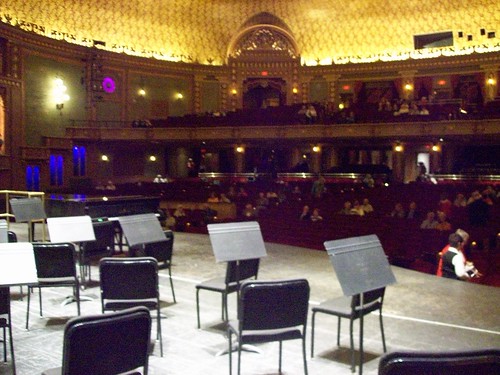
The view from the stage before the concert.
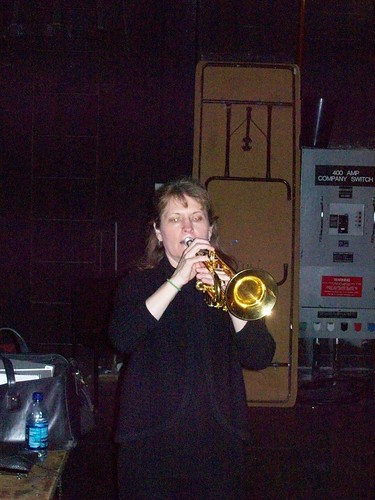
Principal Trumpet Cathy Leach warming up for Mahler 5. (Great job last night, Cathy!)
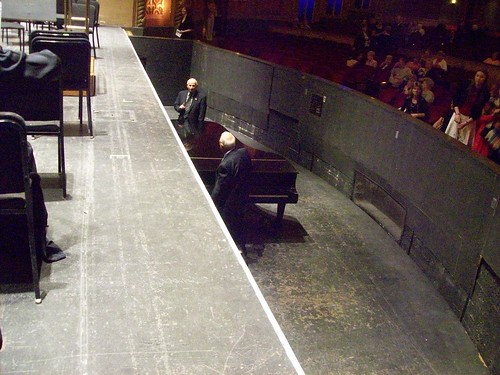
Putting the piano away at intermission. This is still my favorite thing about the Tennessee Theater renovation. So neat!
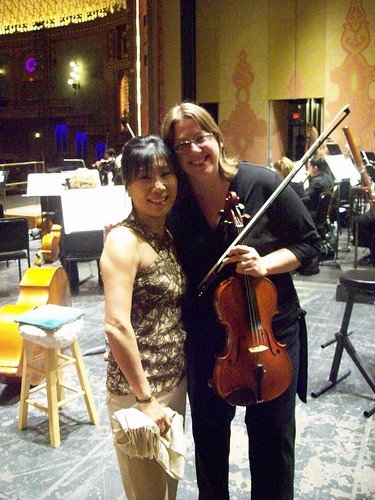
The end of the season has taken it's toll on a few musicians. Assistant principal violist (and my stand partner) Eunsoon Corliss is nursing an injury and couldn't play with us this week, but she came to listen last night. Here we are at intermission.
One of these things is not like the others, one of these things doesn't belong... Just kidding, Jim! Jim Fellenbaum is more often seen on the podium as KSO's resident conductor. This week he was gracious enough to jump into the cello section at the last minute.
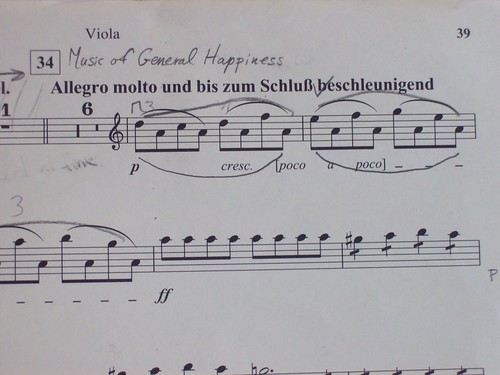
This is the marking we have at the top of the last page of the Mahler. (Yup, the viola part is 39 pages long.) I can't think of anything more appropriate for the end of the season than "Music of General Happiness." It has been a great season, and I'm looking forward to '09 -'10!
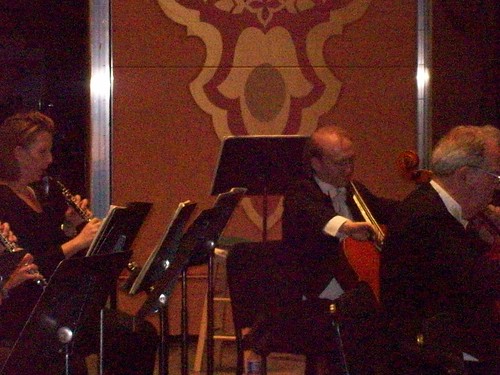
The view from the stage before the concert.
Principal Trumpet Cathy Leach warming up for Mahler 5. (Great job last night, Cathy!)
Putting the piano away at intermission. This is still my favorite thing about the Tennessee Theater renovation. So neat!
The end of the season has taken it's toll on a few musicians. Assistant principal violist (and my stand partner) Eunsoon Corliss is nursing an injury and couldn't play with us this week, but she came to listen last night. Here we are at intermission.
One of these things is not like the others, one of these things doesn't belong... Just kidding, Jim! Jim Fellenbaum is more often seen on the podium as KSO's resident conductor. This week he was gracious enough to jump into the cello section at the last minute.
This is the marking we have at the top of the last page of the Mahler. (Yup, the viola part is 39 pages long.) I can't think of anything more appropriate for the end of the season than "Music of General Happiness." It has been a great season, and I'm looking forward to '09 -'10!
Thursday, April 16, 2009
Mikey Likes It!
Modern music is an acquired taste. Actually, all music is an acquired taste. I can't think of a single piece that I fell in love with the first time I listened to it whether it was Bach or Bartok. I can think of several pieces that I abhorred the first time I heard them only to really enjoy them after listening to them a few times. I wasn't wild about the Sibelius violin concerto the first time I heard a recording of it, for example, and now it is one of my favorite violin concerti. Same story with Beethoven's Ninth Symphony and Stravinsky's Petroushka, which are two of my “desert island” pieces.
No matter if the orchestra is playing Messiaen or Mendelssohn, there are easy things you can do to make your concert going more fulfilling. Check out the program beforehand. If there is a piece or two that you aren't familiar with, find a way to listen to them. The public library is a great source for classical music recordings as are the various online sources of MP3 files. Read the program notes either online or before the concert starts. Often times there is information about the pieces that is crucial to understanding the music. An example of this is Messiaen's Les Offrandes Oubliees, which we will be performing tonight. Messiaen wrote the piece in three distinct sections that are played without pause. The sections represent Christ's sacrifice, human sin, and the Eucharist. It is certainly possible to enjoy listening to the piece on its own, but knowing what Messiaen intended to depict adds a whole new dimension to the listening experience.
Two other ways to become familiar with the music prior to the performance is to listen to Lucas' podcast and to attend the pre-concert chat. I am a big fan of the pre-concert chat. It is free to anyone with a ticket and is held in the theater an hour before the performance. Lucas talks about the pieces we will play and often plays snippets from recordings so you know what to listen for. When we have a soloist they will sometimes join in the pre-concert chat which is a fun way to get to know more about them than what they publish in their bio.
Remember: all music was once modern music. A piece that you dislike the first time you hear it may well turn out to be a favorite after you get to know it better.
No matter if the orchestra is playing Messiaen or Mendelssohn, there are easy things you can do to make your concert going more fulfilling. Check out the program beforehand. If there is a piece or two that you aren't familiar with, find a way to listen to them. The public library is a great source for classical music recordings as are the various online sources of MP3 files. Read the program notes either online or before the concert starts. Often times there is information about the pieces that is crucial to understanding the music. An example of this is Messiaen's Les Offrandes Oubliees, which we will be performing tonight. Messiaen wrote the piece in three distinct sections that are played without pause. The sections represent Christ's sacrifice, human sin, and the Eucharist. It is certainly possible to enjoy listening to the piece on its own, but knowing what Messiaen intended to depict adds a whole new dimension to the listening experience.
Two other ways to become familiar with the music prior to the performance is to listen to Lucas' podcast and to attend the pre-concert chat. I am a big fan of the pre-concert chat. It is free to anyone with a ticket and is held in the theater an hour before the performance. Lucas talks about the pieces we will play and often plays snippets from recordings so you know what to listen for. When we have a soloist they will sometimes join in the pre-concert chat which is a fun way to get to know more about them than what they publish in their bio.
Remember: all music was once modern music. A piece that you dislike the first time you hear it may well turn out to be a favorite after you get to know it better.
Thursday, March 19, 2009
Hunger
1 in 8 people in our country do not have enough food to eat. In East Tennessee the numbers are worse: 1 in 6 people will go hungry tonight. In Knox county alone there are over 16,000 children who are at risk for hunger. Many people struggling with hunger are members of the “working poor.” They fall in the crack of being too wealthy to qualify for many social services but too poor to make ends meet.
No one should have to worry about where their next meal is coming from. You can help. Tonight and tomorrow the Knoxville Symphony is one of 240 orchestras across the country that are participating in a nation wide food drive. Helping is easy. When you come to our concert, bring a can of non-perishable food with you. Heck, bring as many cans as you can carry! We DO live in the Volunteer state, after all. Wouldn't it be great if we all filled the lobby of the Tennessee Theater with donations? What might seem like a small gesture to you will make an enormous difference to someone in need.
The concert, by the way, will be awesome. Elena Urioste is an amazing and dynamic violinist. Her playing is powerful and she's fun to watch. The rest of the program is equally impressive. There is no piece that demonstrates the sheer force of the orchestra like a live performance of Bolero. I can't describe it, it's something you just have to experience. A recording does not do the piece justice. Come, and bring a canned good. You won't be sorry.
No one should have to worry about where their next meal is coming from. You can help. Tonight and tomorrow the Knoxville Symphony is one of 240 orchestras across the country that are participating in a nation wide food drive. Helping is easy. When you come to our concert, bring a can of non-perishable food with you. Heck, bring as many cans as you can carry! We DO live in the Volunteer state, after all. Wouldn't it be great if we all filled the lobby of the Tennessee Theater with donations? What might seem like a small gesture to you will make an enormous difference to someone in need.
The concert, by the way, will be awesome. Elena Urioste is an amazing and dynamic violinist. Her playing is powerful and she's fun to watch. The rest of the program is equally impressive. There is no piece that demonstrates the sheer force of the orchestra like a live performance of Bolero. I can't describe it, it's something you just have to experience. A recording does not do the piece justice. Come, and bring a canned good. You won't be sorry.
Monday, March 16, 2009
German
I studied Spanish in high school and French in college, but my current fluency in either language is very limited save a few choice phrases. I'll be sunk if I ever have to really communicate in a French or Spanish speaking country unless the conversation revolves around roller skating, ice cream, or the days of the week. Still, my study of these languages along with my (forced) extensive study of Greek and Latin word roots in junior high has been beneficial. Italian markings are the most common in music, but sometimes composers use French or German. I am usually able to decipher the composer's wishes without much trouble when the terms are written in Italian or French through my slight knowledge of Romance languages. It's also helpful that the same terms show up over and over again.
German is another story. German is my nemesis. Every summer for too many years I have set out to conquer German musical terms and every time I have failed miserably. I've tried many things to learn these terms: flashcards, listening to a recording with the term followed by the meaning, and incorporating them into my everyday language. I tried the latter tactic the summer after my daughter was born saying things like, “Alice is a little bewegt (agitated). I think a bath might make her more ruhig (peaceful).” There are a few problems with this tactic. One is that while I can now narrow down a terms meaning to two definitions I have a really hard time remembering which is the correct one. It's not a good idea to play bewegt when the music calls for ruhig and vice versa.
The other problem is that composers who use German terms tend to be florid in their use of the language. A knowledge of a body of terms is certainly helpful but it is useless when you are confronted with a long description of how things should be played. A good example of this occurs in Hindemith's Sonata for Solo Viola, op. 25 no. 1. The tempo marking for the fourth movement is quarter note equals 600-640 (really, really FAST) and the instruction roughly translates to, “Crazy tempo. Wild. Tone quality is irrelevant.” Another marking translates to “Very fresh and taut.” These are not the usual fast-slow, loud-soft words that I would expect to find in a score. They are also phrases that defy listing in a music dictionary. I'm very lucky that my father-in-law is a German professor because when I stumble on a long thorny phrase my answer is a phone call away.
This week the symphony is rehearsing Till Eulenspiegels Merry Pranks by Richard Strauss. Strauss is one of those composers who uses German terms in addition to the usual Italian. No brow-furrowing phrases, but I will be spending plenty of time with my music dictionary this week.
German is another story. German is my nemesis. Every summer for too many years I have set out to conquer German musical terms and every time I have failed miserably. I've tried many things to learn these terms: flashcards, listening to a recording with the term followed by the meaning, and incorporating them into my everyday language. I tried the latter tactic the summer after my daughter was born saying things like, “Alice is a little bewegt (agitated). I think a bath might make her more ruhig (peaceful).” There are a few problems with this tactic. One is that while I can now narrow down a terms meaning to two definitions I have a really hard time remembering which is the correct one. It's not a good idea to play bewegt when the music calls for ruhig and vice versa.
The other problem is that composers who use German terms tend to be florid in their use of the language. A knowledge of a body of terms is certainly helpful but it is useless when you are confronted with a long description of how things should be played. A good example of this occurs in Hindemith's Sonata for Solo Viola, op. 25 no. 1. The tempo marking for the fourth movement is quarter note equals 600-640 (really, really FAST) and the instruction roughly translates to, “Crazy tempo. Wild. Tone quality is irrelevant.” Another marking translates to “Very fresh and taut.” These are not the usual fast-slow, loud-soft words that I would expect to find in a score. They are also phrases that defy listing in a music dictionary. I'm very lucky that my father-in-law is a German professor because when I stumble on a long thorny phrase my answer is a phone call away.
This week the symphony is rehearsing Till Eulenspiegels Merry Pranks by Richard Strauss. Strauss is one of those composers who uses German terms in addition to the usual Italian. No brow-furrowing phrases, but I will be spending plenty of time with my music dictionary this week.
Thursday, February 26, 2009
A Composer with a Pulse
Mark Harrell plays horn in the orchestra, but this week he has been sitting in the audience listening to us play a piece that he composed. Lucas is a champion of modern music, so it's not unusual for the KSO to perform pieces by living composers. This week has been different because Mark has attended our rehearsals and given the orchestra instruction on how he wants his piece to be played. Working directly with a living composer can be very rewarding or very frustrating. I always find it somewhat intimidating. Some composers get quite cranky when the live product doesn't exactly match the performance in their head. Mark is pretty easy-going, so it has been a joy to have the opportunity to work with him this week. I enjoy playing his music. He writes pieces that are easy to listen to. They are tonal and he generally follows conventional form. I also appreciate that the parts he writes for strings are idiomatic to the instrument.
The other unusual piece we are playing this week is Brahms' Liebeslieder Waltzes. This is a group of nine short waltzes with a chamber choir. The waltzes are often performed by choirs, but hardly ever with orchestral accompaniment. In preparation for this concert, many of my colleagues (including Maestro Richman) searched for a recording of the Liebeslieder Waltzes with orchestra and nobody could find one. It's too bad no one has recorded them because they are absolutely charming.
The next four days are packed with concerts for the KSO. Tonight and Friday the larger orchestra will perform at the Tennessee Theater while the chamber orchestra will perform at the Bijou on Sunday afternoon. The programs are different but share some elements. We will be playing Brahms' Liebeslieder Waltzes at all three concerts. The chamber concert will also feature Mendelssohn's Italian Symphony.
The other unusual piece we are playing this week is Brahms' Liebeslieder Waltzes. This is a group of nine short waltzes with a chamber choir. The waltzes are often performed by choirs, but hardly ever with orchestral accompaniment. In preparation for this concert, many of my colleagues (including Maestro Richman) searched for a recording of the Liebeslieder Waltzes with orchestra and nobody could find one. It's too bad no one has recorded them because they are absolutely charming.
The next four days are packed with concerts for the KSO. Tonight and Friday the larger orchestra will perform at the Tennessee Theater while the chamber orchestra will perform at the Bijou on Sunday afternoon. The programs are different but share some elements. We will be playing Brahms' Liebeslieder Waltzes at all three concerts. The chamber concert will also feature Mendelssohn's Italian Symphony.
Monday, February 23, 2009
Remembering Brahms
Last night we rehearsed Brahms' Second Symphony in preparation for our Masterworks concerts on Thursday and Friday. I love all of Brahms' symphonies, but the second has a special place in my heart. It was the first CD of orchestral music that I owned (and wore out), and it also represents my first experience playing real symphonic music with a group of my peers. I first played this symphony at a summer camp when I was 14 years old. Prior to attending that camp my orchestral experience had been with my school orchestra where none of my peers were quite as excited about playing the violin as I was, and the local community orchestra, where I was by far the youngest player: my stand partner was a biology professor nearing retirement. I enjoyed both groups, but they were nothing like that week at summer camp. For the first time, I was surrounded with peers who were just as passionate about making music as I. It was an incredible experience, and one that solidified my desire to make music my career.
Kids in Knoxville don't have to wait for summer camp to play in an orchestra with peers who love music. Knoxville has a youth orchestra program that is supported by the Knoxville Symphony Orchestra League and the Knoxville Symphony Society. The Knoxville Youth Symphony Orchestra is made up of five ensembles of varying levels with over 250 students participating each year. The orchestras meet once a week to rehearse and give around three concerts a year. These are not the typical student music performances that you may have suffered through as a child (or as a parent of a child in band or orchestra). The kids work hard in rehearsal and on their own to really master the music. The result is a polished, exciting performance. As it happens, the Knoxville Youth Symphony Orchestras are performing tonight at 7:00 in the Tennessee Theater. The concert is free and open to the public. I would advise you to get there early to stake out your seat because these concerts are quite popular and often fill the house. It's a wonderful way to spend an evening.
Kids in Knoxville don't have to wait for summer camp to play in an orchestra with peers who love music. Knoxville has a youth orchestra program that is supported by the Knoxville Symphony Orchestra League and the Knoxville Symphony Society. The Knoxville Youth Symphony Orchestra is made up of five ensembles of varying levels with over 250 students participating each year. The orchestras meet once a week to rehearse and give around three concerts a year. These are not the typical student music performances that you may have suffered through as a child (or as a parent of a child in band or orchestra). The kids work hard in rehearsal and on their own to really master the music. The result is a polished, exciting performance. As it happens, the Knoxville Youth Symphony Orchestras are performing tonight at 7:00 in the Tennessee Theater. The concert is free and open to the public. I would advise you to get there early to stake out your seat because these concerts are quite popular and often fill the house. It's a wonderful way to spend an evening.
Subscribe to:
Comments (Atom)